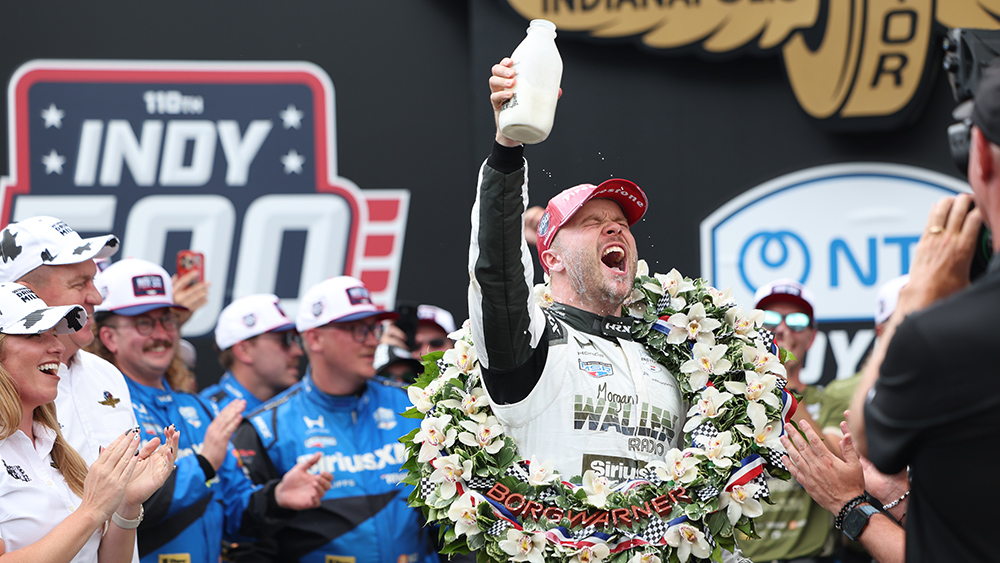
On a day that will be remembered for decades at Indianapolis Motor Speedway, Felix Rosenqvist delivered a victory that came down to inches, not seconds. In the 110th running of the Indianapolis 500 presented by Gainbridge, Rosenqvist edged David Malukas by just .0233 of a second in the closest finish in race history.
The finish came in a last-lap drag race to the Yard of Bricks after 200 laps of nonstop intensity, strategy, and survival. Rosenqvist, driving the No. 60 Honda for Meyer Shank Racing, used the high line near the wall exiting Turn 4 and surged ahead in the final moments to secure his first Indy 500 win.
Malukas, driving for Team Penske, tried every defensive move he could in the closing stretch, even changing lines in an attempt to break the draft. But Rosenqvist stayed glued to his rear bumper before pulling alongside and finally edging ahead at the line.
The margin was so close it broke the record for the tightest finish in Indy 500 history. The previous mark was set in 1992 when Al Unser Jr. beat Scott Goodyear by .043 seconds.
For Rosenqvist, the win capped what he called a “magical May.” Just weeks earlier, he and his wife Emille welcomed their first child, a daughter named Stella. He said the month felt unreal, balancing fatherhood with the biggest victory of his racing career.
The race itself was one of the most competitive ever run at Indy. A record 70 lead changes took place over 200 laps, showing just how evenly matched the field was from start to finish. In total, more than 600 on-track passes kept the crowd of over 300,000 on edge throughout the afternoon.
Rosenqvist became only the third Swedish driver to win “The Greatest Spectacle in Racing,” joining Kenny Bräck and Marcus Ericsson in Indy 500 history.
The final restart that set up the finish came after a late caution involving rookie Mick Schumacher, which triggered a one-lap shootout for the win. Cars lined up for what became a sprint to the finish, with no room for error.
On that final lap, Malukas briefly took the lead entering Turn 1 and looked strong on the backstretch. Behind him, Rosenqvist and Marcus Armstrong battled side by side before Rosenqvist committed to the high line and began closing the gap.
As the cars approached Turn 4, Rosenqvist swept around Armstrong and drew even with Malukas. The two raced side by side all the way to the Yard of Bricks, where Rosenqvist crossed first by roughly half a car length.
Malukas finished second and was visibly emotional afterward, saying he felt like his team had the fastest car all day and gave everything they had.
Behind them, Scott McLaughlin finished third in the No. 3 Chevrolet for Team Penske, followed by Pato O’Ward and Marcus Armstrong in the top five. Just behind them, Alex Palou led a race-high 59 laps but finished seventh after strategy shifts late in the race.
The event also featured a mix of fuel strategy battles, late cautions, and a red flag period that reshuffled the field heading into the final sprint. Several contenders, including O’Ward and Rosenqvist, managed fuel carefully in the closing stint before the final caution erased any long-run strategy.
Despite the chaos, Rosenqvist stayed calm in traffic and positioned himself for the final push when it mattered most.
In the end, it was a race defined by precision at full speed, where timing, drafting, and nerve all came together in the final seconds. Rosenqvist’s win will go down not only as a career highlight, but as one of the closest and most dramatic finishes in Indy 500 history.


