
The Formula 1 Japanese Grand Prix is in the books, and the third race of the season provided plenty of talking points.
Mercedes’ Kimi Antonelli continued to write his name into F1 history. McLaren showed that they are a real threat to the Silver Arrows’ dominance. Red Bull’s Max Verstappen is threatening to leave the sport.
Read on for five things we learned from an action-packed weekend at Suzuka.
The origin story of a new legend
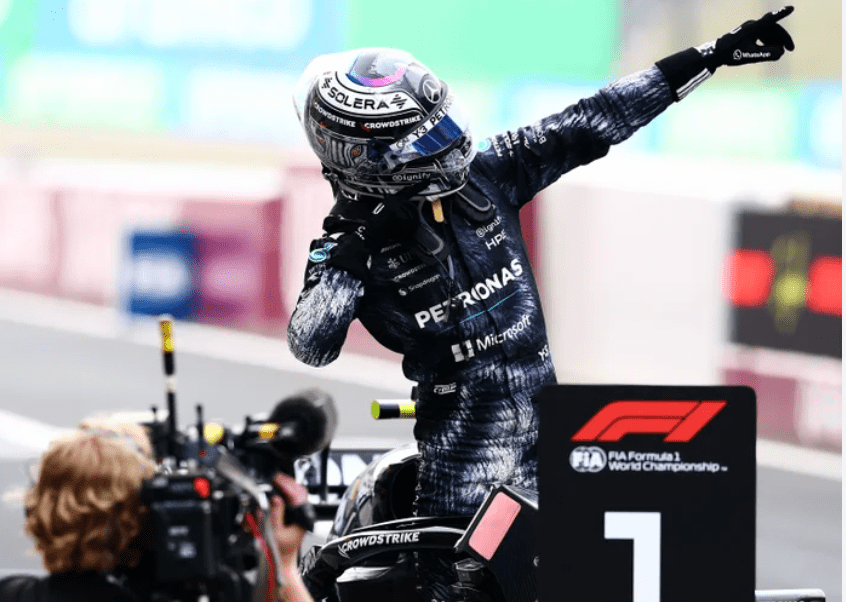
It’s difficult to put into words the magical season the 19-year-old Antonelli in enjoying. The Mercedes driver won his second consecutive Grand Prix in Japan, becoming the youngest F1 driver ever to do so. And it wasn’t easy.
Both Mercedes’ cars had to overcome a terrible start, with Antonelli quickly dropping from pole position to 6th within the first few seconds. Antonelli passed Ferrari’s Lewis Hamilton on lap 2 to regain a place. He worked his way up to fourth by lap 15, when he briefly passed Ferrari’s Charles Leclerc to take P3…only to have Leclerc take back the place after Antonelli nearly lost control of his car.
On lap 19, race leader Oscar Piastri (McLaren) pitted for fresh tires, despite the fact he was gaining time on Mercedes’ George Russell in P2. With Piastri in the pits, Antonelli took over P2. On older tires, he immediately rocketed to the fastest lap of the race, a full 0.7 seconds quicker than Piastri’s best time.
On lap 21, Russell boxed for fresh rubber, giving Antonelli the lead. Then, on lap 22, Haas’ Oliver Bearman suffered a 50G crash, bringing out the safety car. This gave Antonelli a free pit stop for new tires.
Of course, luck is important in any Grand Prix. But the fact is Antonelli was absolutely flying in the second half of the race compared to Piastri, even though Antonelli’s hard tires that were only three laps newer than Piastri’s rubber.
Antonelli increased the time gap between them to five seconds in the first eight laps following the end of the safety car. Antonelli eventually extended his lead over Piastri to 13.7 seconds at the checkered flag.
If you’re one of the lucky ones who didn’t walk away from F1 this season grumbling about the “stupid electric cars,” be aware you’re watching the origin story of what could become an historic career.
More superlatives from the young man from Bologna, Italy, who is now in his second season in F1:
- Youngest to win multiple races in F1 history
- Youngest pole‑sitter in F1 history (Chinese GP)
- Youngest driver to win from pole (same)
- Youngest to lead a lap in F1 history (same)
- Youngest to set the fastest lap (same)
- Youngest driver to score a hat trick (pole + win + fastest lap) (same)
- Youngest World Championship leader ever: After his Japan GP victory, he became the youngest to lead the Drivers Championship table
- First Italian driver to win consecutive Grand Prix since Guiseppe Farina (German Grand Prix) and Alberto Ascari (Swiss Grand Prix) in 1953
By comparison, Max Verstappen remains the youngest driver to win a GP. He was about six months younger than Antonelli is now when he claimed the Spanish GP title in 2016.
The youngest driver to win the World Championship? Lewis Hamilton was two months shy of his 24th birthday when he won the 2008 title. So, yes, Antonelli still has five years remaining to break Hamilton’s record.
McClaren finally gets it right
After winning the Constructors Championship in 2024 and 2025, McLaren’s start to the 2026 season was excruciating. In the opener in Australia, Oscar Piastri crashed out on a warm-up lap, and defending world champion Lando Norris finished P5.
In China, they suffered the ignominy of a double DNF when both cars failed to start due to power-unit electrical faults.
At Suzuka, Team Papaya enjoyed a significant bounceback result. Piastri finished P2, marking McLaren’s first podium of the year and a strong points haul. It was also the first time a McLaren finished ahead a Mercedes this season. Piastri uttered the best line of the weekend on his cool-down lap: “When we start these things, we’re pretty good.”
Norris also scored solid points with a fifth‑place finish, giving McLaren double points and extending their third-place cushion over Haas in the Constructors Championship standings.
Ferrari’s problems are becoming crystal clear
Ferrari left the Japanese Grand Prix with a podium (Charles Leclerc in P3), but there’s mounting evidence that its 2026 package is fundamentally weak. The headline problem is straight-line speed, and the data from Suzuka highlight the massive issue.
Ferrari recorded the slowest top speed in the entire F1 field of 22 cars, reaching only about 199 mph, leaving them consistently vulnerable on the run to key overtaking zones. By comparison, George Russell nailed the fastest speed of the day: ~205 mph.
Telemetry comparisons showed that even when Ferrari gained time through Suzuka’s corners, rivals erased that advantage on the straights thanks to superior energy deployment and higher terminal velocity.
The problem appears multidimensional: A mix of higher aerodynamic drag, conservative energy deployment and/or weaker electrical efficiency within Ferrari’s hybrid system.
Until Ferrari unlocks more efficient deployment and reduces drag, circuits with long acceleration zones will continue to expose the SF-26’s limitations.
The midfield battle is hotter than two randy rats in a sock
Anyone who thinks F1 racing is boring just needs to clock the fight among the midfield teams.
Coming out of Japan, four teams — Haas (18 points), Alpine (16), Red Bull (16) and Racing Bulls‑RBPT Ford (14) — are within four points of each other.
For Alpine, Pierre Gasly notched his third-straight race in the points, as he took P7 at Suzuka. Unfortunately for them, Franco Colapinto slumped to P16 after finishing 10th in China.
Fans of Haas were left shaking after watching Oliver Bearman suffer a 50G crash in Japan. His teammate, Estaban Ocon, finished P10 to allow their midfield rivals to close the gap in the Constructors Championship.
We know Red Bull has been struggling all season — and Japan was no exception. Verstappen finished 8th and Isack Hadjar was 12th.
Racing Bulls had a difficult day. Liam Lawson was P9 in Japan, scoring points but dropping two places from his finish in China. Meanwhile, rookie Arvid Linblad has been regressing since earning an impressive P8 in Australia. He finished 12th in China and 14th in Japan.
And if you don’t think the midfield battle is crucial, just remember the Constructors Championship prize money. The fourth-place team in 2026 is expected to win $113 million, while the team in seventh will take home $87 million, a delta of $26 million. By comparison, it takes roughly $20 million to build one F1 car.
Max, take your ball and go home
We’ve always loved Verstappen because he says what he thinks. In an era when most F1 drivers simply spout talking points from their PR flaks in order to keep sponsors happy, Max has been refreshingly candid.
But lately he’s been sounding like a petulant 7-year-old who isn’t allowed to stay up past his bedtime. With both Red Bull cars struggling this season, Max can’t stop complaining. He’s adamant that the newly redesigned cars are holding him back.
After finishing P8 in Japan, he hit the boost button on his whining. Now he’s hinting he’ll walk away after this season — with two years remaining on his contract — because the cars aren’t to his liking.
“When you are in P7 or P8 and you are not enjoying the whole formula behind it, it doesn’t feel natural to a racing driver,” he said. “Of course I try to adapt to it, but it’s not nice the way you have to race. It’s really anti-driving. Then at one point, yeah, it’s just not what I want to do.”
Guess what Max? F1 was doing fine before you joined and made us watch you win four consecutive Drivers Championships; and F1 will do fine after you’re gone. Don’t let the garage door hit you in the arse on the way out.

 Full Throttle Media