
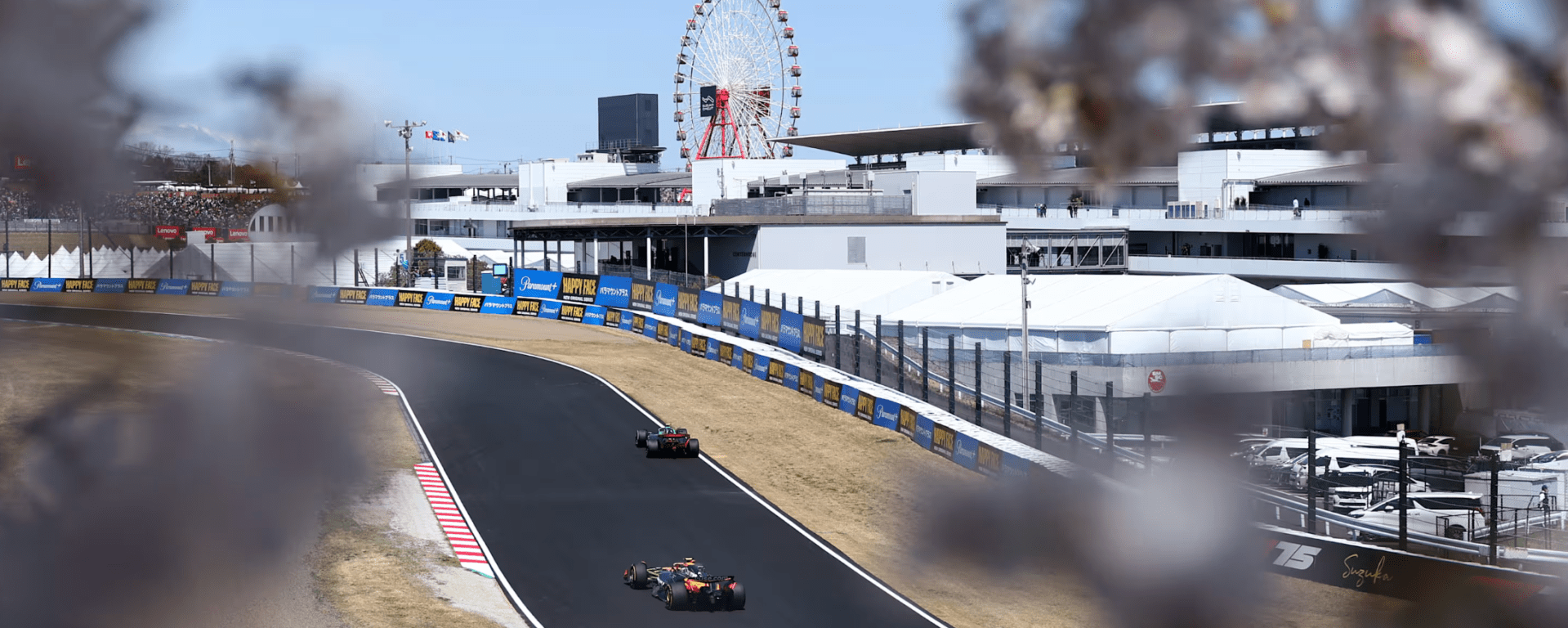
Formula 1 is in Japan this weekend at a track that’s known as one of the favorite circuits among both drivers and fans: Suzuka. So far this season, Mercedes has dominated the first two Grand Prix, with George Russell and Kimi Antonelli flipflopping P1 and P2 in Australia and China, respectively.
Will their run of success continue? We analyze this question while offering five things to watch for in the Land of the Rising Sun.
Will Mercedes institute team orders?
The early race for the Drivers Championship paints a fascinating picture inside Mercedes. Russell entered the season as the clear team leader, but Antonelli’s immediate pace has altered the status quo. With the two drivers separated by only four points, the team faces a classic quandary:
Should Mercedes play it safe, anoint Russell as the clear team leader and look to maximize points for the Constructors Championship? Or allow an open competition for the drivers’ title?
Suzuka will reveal the first real sign of Mercedes’ strategy. The circuit emphasizes qualifying position and strategic control, with teammates often impacting one another’s race via drafting, pit-stop timing and holding position in traffic. If both cars run near the front, Mercedes may need to decide whether to impose team orders or let them race.
Will the battle over Mercedes’ compression temps reach a boiling point?
This controversy goes back a few months but may come to a head at Suzuka. Under new engine regulations, compression ratio is capped at 16:1, with the measurement defined at ambient (cold) temperature.
Some engineers (ahem…Mercedes…ahem) realized compression would change when engines heat up. Mercedes’ new power unit reportedly complied at 16:1 cold, but rose higher at operating temperature. Their rivals suspected this skirted the rules while effectively increasing power output.
In February, the FIA agreed to revise testing methods to address the discrepancy, essentially checking compression at operating temperature as well as cold.
Of course, Merc has dominated racing through the first two Grand Prix, leaving rivals fuming. Red Bulls’ Max Verstappen claimed the loophole gives the Silver Arrows an extra 20 to 30 horsepower and a benefit of 0.3 seconds per lap.
The bad news for Max and the other teams is that the FIA has ruled Mercedes can continue using the design until mid-season, while new tests are being finalized. If Mercedes continues to outclass its opponents, look for the debate to reach a boiling point in Japan.
How will electrical energy management on a high-speed track play out?
Everyone loves Suzuka because it rewards flat-out commitment, with high-speed esses, the famous 130R taken at near top speed and other flowing arcs where, in the past, lifting even slightly has cost drivers time.
But under the 2026 rules, energy deployment might change this vibe.
With the updated power units relying greatly on electrical power output, drivers have a limited battery allocation per lap. At a start-stop track, they can recover energy under braking. But at flowy Suzuka, there are fewer heavy braking zones, so power recovery is limited
If they push too hard too early, they’ll drain the battery. That could mean less power on the long back run between Spoon Curve and turn 16.
While watching the race, keep an eye out for drivers who lift somewhat through the high-speed corners to save energy for the straights.
Also, this will be a huge test of the FIA’s new regulations. If drivers are forced to lift in iconic corners and the racing suffers, expect tweaks to energy limits or recovery rules to come.
Will the “other” U.S. team continue to outperform?
The new U.S. F1 entry, Cadillac F1 Team, has created insane amounts of hype. But it’s important to remember that the U.S. already has a team delivering results: Haas.
They sit just one point behind McLaren in the constructors’ standings and have shown consistent midfield pace early in the season. Reliability, often a Haas weakness, has been solid so far
Oliver Bearman has been the standout. He sits fifth in the drivers’ standings with 17 points, ahead of Lando Norris on 15. Bearman scored points in both races, including a top-five finish in China and another points result in Australia.
Estaban Ocon hasn’t scored yet but has provided solid midfield pace and track position that’s helped Haas remain competitive in strategy battles.
Will McLaren’s woes continue?
After winning the Constructors Championship in both 2024 and 2025, Team Papaya’s results so far in 2026 have been downright embarrassing. They currently sit third in the table, a massive 49 points behind Ferrari.
McLaren suffered the ignominy of a double DNF in China when both cars failed to start due to power-unit electrical faults. Can they right the ship in time?
Norris and Oscar Piastri have shown flashes of speed over one lap, but the cars struggled with tire degradation during the Australian Grand Prix. Moreover, they seem to be running a deficit to other teams when it comes to straight-line top speed.
This could hurt McLaren’s performance on the long back straight coming out of Spoon Curve (mentioned above), as well as the start-finish straight that comes quickly after turn 16. Keep a sharp eye on Team Papaya’s times in this important third sector to find out if they have made any progress in improving the car.

 Full Throttle Media