
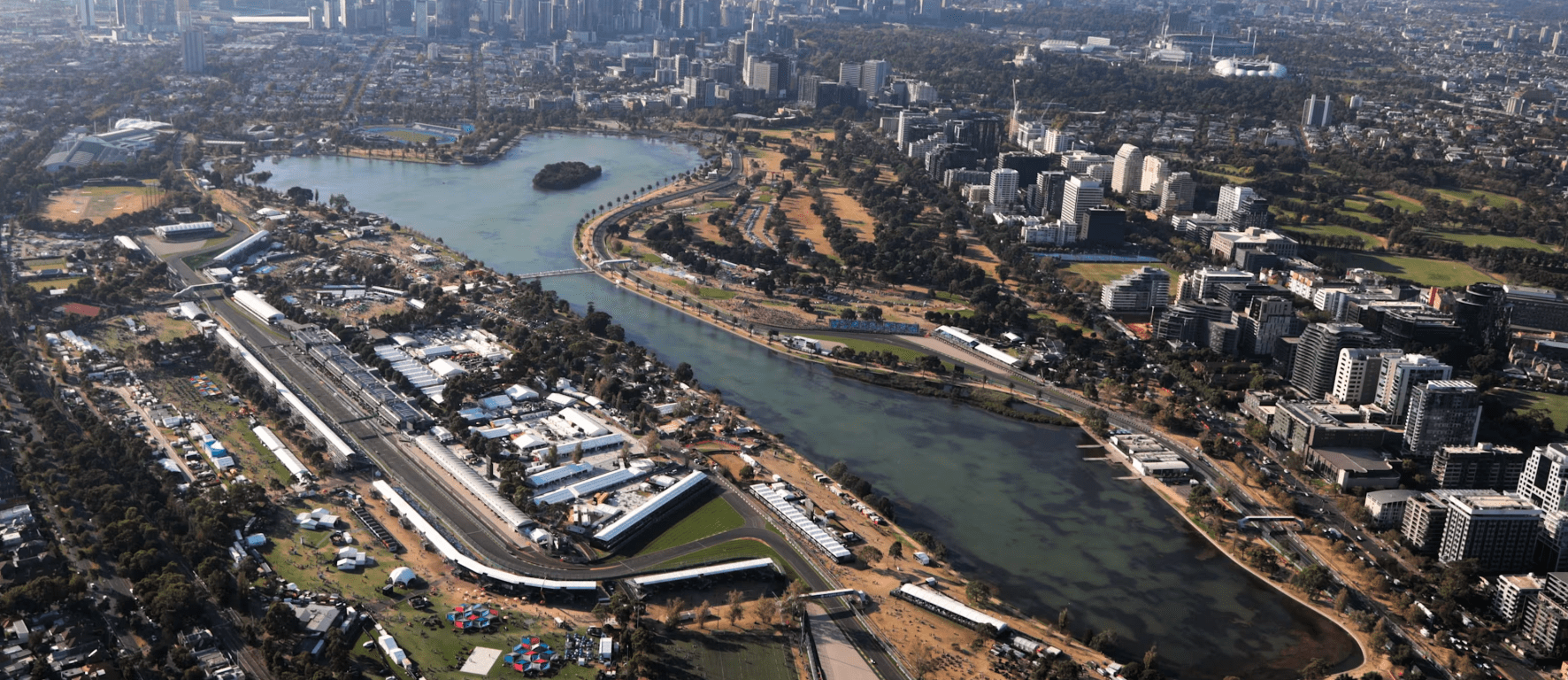
The 2026 Formula 1 season kicks off in Melbourne, Australia, this week — and it’s positioned to be a season like no other. Read on for the five most interesting things to watch for as the drivers take to the track.
1. What you need to know about the circuit
Lights out at the Australian Grand Prix occurs Saturday, March 7, at 11 p.m. Eastern time. Yes, 11 p.m. U.S. viewers can watch on AppleTV.
Since 1996, the race has been held at Albert Park in Melbourne. The semi-permanent circuit winds around Albert Park Lake, mixing public roads with built-for-purpose sections. The course is known for its smooth surface and mix of medium- and high-speed corners with several heavy braking zones.
One lap of the track measures 3.280 miles, and the race will cover 58 laps. Ferrari’s Charles Leclerc holds the fastest-lap record of 1:19.813, set in 2024. Last season, McLaren’s Lando Norris won the Grand Prix here, followed by Red Bull’s Max Verstappen and Norris’ teammate Oscar Piastri.
2. New regulations require new driving skills
This season marks what’s being called the most significant rule changes in the sport’s history. In short, the cars are smaller and lighter — roughly 70 pounds lighter — which will make them nimbler. Drag has been reduced but so has downforce. Moreover, the 18-inch tires are narrower. All these changes could make the cars more squirrely, placing more demands on the driver when it comes to handling.
The turbo-hybrid power unit has been overhauled, resulting in a roughly 50/50 split between power from the internal combustion engine and electric energy from the battery.
But drivers will need to be judicious about using that power. They can now activate Boost mode to deploy combined engine and battery power (assuming the battery has the needed energy) anywhere on the track. In the past, teams would often refer to this on race radios “overtake” to let drivers know the battery was charged enough to maximize total output.
Moreover, a driver can kick in Overtake Mode when he’s within one second of a car in front. This provides added electrical power for attacking and replaces the old drag reduction system.
In addition, cars now sport what’s called Active Aero that enables drivers to switch between two modes of aerodynamic performance: Z-mode (the default setting), which adds downforce for grip in corners; and X-mode, which reduces drag to add speed on certain straightaways.
Add all these up, and we see new demands placed on the drivers. And we’re all for it! Formula 1 was founded decades ago to showcase the best drivers on the planet, alongside the hottest racing tech. In the past two decades or so, however, tech has become more important than driving skill. Going forward, we’re hopeful that the new regulations will put the biggest decisions in the hands of the drivers. Yes, we still love our engineers. But this sport is about driving, not just designing and fabricating.
3. The start could see utter chaos
The first taste we’ll get of the impact of the new regulations will be immediately at the start of the Australian Grand Prix. Things could well become chaotic very quickly as drivers struggle with getting off the line cleanly. The primary reason is because of potential turbo lag.
Under the old rules, the cars’ motor generator unit-heat (MGU-H) would spin the turbo as cars were waiting at the start. But now the MGU-H is gone, so the turbo must rely only on exhaust gases to spin. The problem is obvious: How will the cars produce enough exhaust gases to spin the turbo fast enough when sitting at the start line?
That’s turbo lag: The delay between hitting the throttle and receiving the turbo’s full power output.
Some have suggested the drivers will be revving their engines to spin the turbo just prior to lights out. This will require them to release the clutch at exactly the right time to nail the start.
Again, driving skills — not technology —take precedence here. And we’re all for it.
4. Which team will grab the early advantage?
Based on preseason performance and our crystal ball, here’s what to expect from the top four teams:
McLaren: The two-time defending constructor’s champion could start the season on the defensive. They still seem fast and technically reliable, but they’ve been trailing marginally behind the outright quickness of Ferrari and Mercedes early on. Still, Norris remains the man to beat unless proven otherwise. And Piastri added some new faces to his personal entourage this season, people who have helped him win in the past. So let’s see if he has a new approach to racing.
Ferrari: They displayed serious quickness in preseason shakedowns, particularly Leclerc. He loves this track, so expect him to be one of the early frontrunners in Australia. Lewis Hamilton, coming off one of most disappointing seasons of his career in 2025, made more of the wrong kind of headlines a few weeks ago when it was announced this his race engineer, Riccardo Adami, would be moving into a different role. In Australia, keep an eye on how Hamilton and Adami’s replacement, Carlo Santi, get along.
Mercedes: The Silver Arrows rank among the favorites coming into the first Grand Prix of the year. In preseason action, Mercedes showed consistent mileage and speed, despite several problems with Kimi Antonelli’s car. If you believe the chitchat in the paddock, George Russell will challenge Leclerc for the victory in Melbourne — with a strong showing for Russell adding fuel to the fire that he will challenge for the season-long driver’s championship.
Red Bull: They’re in Australia still working on their new car, so they’ve moderated expectations. All the talk in the garage is that Ferrari and Mercedes have an advantage over Red Bull. While Max Verstappen is known to be a very cagey competitor, the reality is any team that’s replaced its team principal and technical guru (Christian Horner and Adrian Newey) could be expected to struggle early on. Add the fact that Red Bull have an all-new power unit (developed in conjunction with Ford), and maybe the best they can hope for in Australia is to be running with the leaders.
5. Aston Martin already knows they’re doomed
Imagine if the New York Mets flew to Los Angeles to play the Dodgers — and held a press conference at the airport to announce they were only playing three innings.
That’s the bizarre situation Aston Martin finds itself in at the Australian Grand Prix. The team’s new Honda power units suffered embarrassing reliability problems in preseason testing, severely limiting their time on track, providing scant testing data and requiring the use of spare parts.
Recent media reports indicate the team will race very few miles in Melbourne, essentially driving the minimum required to qualify for the Grand Prix and then retiring early from the race to save on parts and give them more time to improve the power unit.
Apparently, Aston Martin even considered abandoning the race entirely. But that would be in violation of F1’s Concorde Agreement and cause serious financial and contractual problems for the team.

 Full Throttle Media