
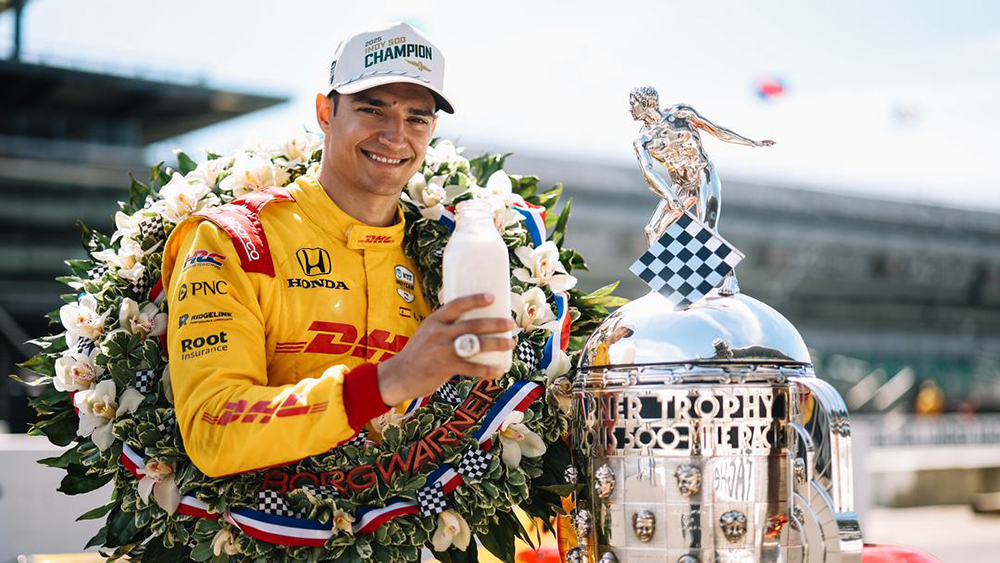
Alex Palou finally has his answer to years of questions about when he’d capture his first Indianapolis 500 victory. The Spanish driver’s patient, calculated approach in the closing stages of the race delivered not just his maiden Indy 500 triumph, but also his first-ever oval victory, cementing his status among IndyCar’s elite.
Driving the No. 10 Chip Ganassi Racing Honda, Palou demonstrated remarkable composure in a race that began with chaos but concluded with his strategic masterpiece. The victory came after a tense final phase where fuel conservation and tactical positioning proved more valuable than raw speed.
The race’s pivotal moment came on lap 187 when Marcus Ericsson, who had taken the lead through an alternate fuel strategy, seemingly left the door open at Turn 1. Palou, who had been content to sit behind the Swede for most of the final 20 laps, seized the opportunity with clinical precision.
“I spotted Devlin DeFrancesco and Louis Foster just ahead,” Palou might have calculated, recognizing that one car’s slipstream is as valuable as another’s. When Ericsson played the long game too conservatively, Palou struck, sliding past into the crucial position behind the final two cars on the lead lap.
The message from his pit wall on lap 196 was music to his ears: “Burn all the fuel you need.” No longer constrained by conservation concerns, Palou could focus purely on track position and defending against Ericsson’s inevitable counterattack.
The last lap provided heart-stopping drama as Ericsson mounted one final challenge. The Swede got a run approaching Turn 3, and for a brief moment, it appeared he might claim his second Indianapolis 500 victory. However, what seemed to be the slightest of wobbles was all Palou needed to maintain his advantage.
A yellow flag for Nolan Siegel’s crash in Turn 2 as the leaders exited Turn 4 sealed the deal, ensuring Palou’s victory would stand unchallenged.
“I cannot believe it,” an elated and hoarse Palou said after the race. “What an amazing day. What an amazing race. There were some moments I felt really good in the race, but at the end I wasn’t sure if I could pass Marcus Ericsson or not. It was tough conditions, especially when we were third or fourth in the pack. The fuel consumption was super high. But [we] made it happen.”
While Palou celebrated, the race was defined equally by the misfortunes that befell many of the day’s favorites. The carnage began before the race even went green, with Scott McLaughlin’s devastating crash during the installation lap providing an early indication of the day’s unpredictable nature.
The New Zealander’s No. 3 Team Penske Chevrolet jinked left into the pitwall while warming tires, breaking the front-left suspension and ending his race before it began. McLaughlin’s anguish was palpable as he sat in the grass with his head in his hands.
“By far the worst day of my life,” McLaughlin said. “I know that sounds dramatic, but you put so much into this day.”
The mechanical failures came in waves throughout the afternoon. Alexander Rossi’s compelling alternate strategy story ended abruptly when his No. 20 ECR Chevrolet developed a gearbox problem that led to a fuel leak and fire in the pits. Moments later, Rinus VeeKay’s heroic climb from 31st to sixth ended when his brakes failed entering the pits, sending him into the wall at 120mph.
Perhaps most dramatically, surprise polesitter Robert Shwartzman’s fairytale weekend concluded when brake failure sent his PREMA car into the wall and several crew members, though thankfully none were seriously injured.
“I touched my brakes and the whole front just locked,” Shwartzman explained. “When I braked I was just a passenger.”
The race claimed several championship contenders, including Josef Newgarden, whose remarkable climb from 32nd on the grid to sixth position ended with a fuel pump failure. The two-time Indy 500 winner had been mounting an impressive charge that could have put a different spin on Team Penske’s difficult weekend.
Kyle Larson’s NASCAR-to-IndyCar double attempt also ended in disappointment when the No. 17 Arrow McLaren Chevrolet spun on a downshift at Turn 1, triggering a three-car crash that also collected Kyffin Simpson and Sting Ray Robb.
Ericsson’s disappointment at another near-miss was evident, but his second-place finish demonstrated the strength of his race-long strategy. David Malukas completed the podium in third place, with his No. 4 AJ Foyt Racing Chevrolet having run with the leaders virtually all day.
Pato O’Ward recovered from a quiet afternoon to finish fourth for Arrow McLaren, while Felix Rosenqvist rounded out the top five for Meyer Shank Racing, providing Honda with four of the top five finishing positions.
Palou’s triumph wasn’t built on dominant speed or lucky circumstances—it was the product of racecraft, patience, and strategic thinking. In a race where many faster cars fell by the wayside due to mechanical failures or strategic miscalculations, the Spaniard’s measured approach and ability to capitalize on the crucial moment proved decisive.
For a driver who has already established himself as one of IndyCar’s premier talents with multiple championships, this Indianapolis 500 victory fills the most significant gap in his racing resume. No longer will he need to answer questions about when he’ll win at the Brickyard—now he can focus on when he’ll win there again.
The 109th Indianapolis 500 will be remembered as the day Alex Palou’s patience finally paid off, delivering him the victory that transforms good drivers into Indianapolis legends.

 Full Throttle Media