
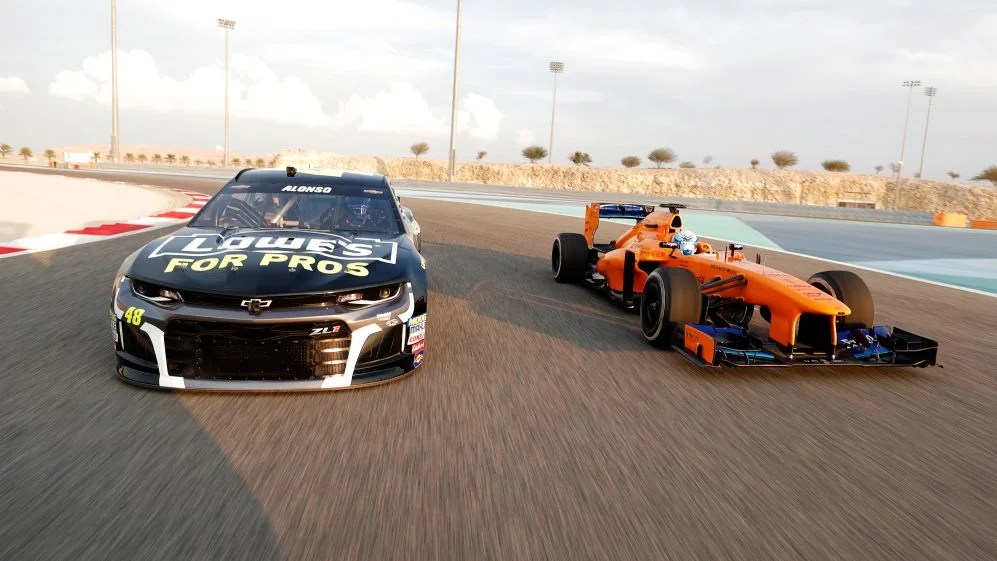
Motorsport is a diverse world, with each discipline offering its own unique challenges and thrills. While NASCAR remains one of America’s most popular racing series, it’s just one flavor in the global motorsport buffet. Let’s compare NASCAR to other prominent forms of motorsport to understand what makes each special.
NASCAR vs. Formula 1
Track Design: NASCAR tracks are predominantly oval-shaped, ranging from 0.5 to 2.66 miles in length. The most famous is perhaps Daytona International Speedway, with its 31-degree banked turns. Recently, NASCAR has incorporated more road courses, like Watkins Glen and Sonoma, into its schedule.
F1, in contrast, races on a variety of road and street circuits. Each track is unique, from the tight corners of Monaco’s street circuit to the high-speed straights of Monza. F1 tracks typically feature a mix of high-speed sections, technical corners, and heavy braking zones.
Car Design: NASCAR vehicles are large, boxy stock cars weighing around 3,200 pounds (1,451 kg). They’re built around a tubular frame chassis with a stock-car body, powered by 5.86-liter V8 engines producing about 750 horsepower. The cars are designed to withstand contact and drafting is a crucial aspect of racing strategy.
F1 cars are the pinnacle of motorsport engineering. They’re open-wheel, single-seater cars weighing just 1,752 pounds (795 kg) including the driver. Current F1 cars use 1.6-liter V6 turbocharged hybrid engines, producing over 1,000 horsepower. Aerodynamics play a crucial role, with complex front and rear wings, and underbody design generating massive downforce.
Race Structure: NASCAR Cup Series races typically last 3-4 hours and are measured by number of laps (usually 200-500). The longest race, the Coca-Cola 600, covers 600 miles.
F1 races are timed events, lasting a maximum of 2 hours or 305 km (189.5 miles), whichever comes first. This usually translates to about 50-70 laps, depending on the circuit.
Pit Stops: In NASCAR, pit stops are more frequent and longer. A typical stop involves changing all four tires and refueling, taking 12-16 seconds. Teams are allowed six crew members over the wall during a stop.
F1 pit stops are incredibly quick, often under 3 seconds, focusing primarily on tire changes. Refueling was banned in 2010 for safety reasons. Up to 20 crew members can be involved in an F1 pit stop.
Global Reach: While NASCAR has made efforts to expand internationally, with exhibition races in Japan and a points-paying race in Mexico, it remains primarily a U.S.-centric sport. The fanbase is concentrated in the American Southeast and Midwest.
F1 is truly global, with races across five continents. The 2023 season features 23 races in 20 countries. Its fanbase is worldwide, with particularly strong followings in Europe, South America, and increasingly in Asia.
NASCAR vs. IndyCar
Track Variety: IndyCar offers more track diversity in its calendar. The series races on four types of tracks: short ovals, superspeedways, road courses, and temporary street circuits. This variety tests drivers’ versatility more than NASCAR’s predominantly oval-based schedule.
Car Design: IndyCars are open-wheel, single-seater vehicles weighing about 1,630 pounds (739 kg) on road/street courses and 1,590 pounds (721 kg) on ovals. They use 2.2-liter twin-turbocharged V6 engines producing 550-700 horsepower depending on the track. The aerodynamic package differs between ovals and road courses.
NASCAR cars, as mentioned earlier, are heavier and more robust, designed for close-quarter racing and occasional contact.
Race Format: Both series have races of similar length for most events. However, IndyCar’s crown jewel, the Indianapolis 500, is significantly longer at 500 miles and typically lasts about 3 hours. It’s considered one of the most prestigious races in the world, alongside the Monaco Grand Prix and the 24 Hours of Le Mans.
Technological Innovation: IndyCar has been more open to technological advancements. For example, it introduced the HANS device (Head and Neck Support) before NASCAR and was quicker to adopt ethanol-based fuels. IndyCar also uses a push-to-pass system, giving drivers extra horsepower for overtaking.
NASCAR has traditionally been more conservative with technology to maintain closer competition and control costs. However, it has recently made significant changes, such as introducing the Next Gen car in 2022 with independent rear suspension and a sequential gearbox.
NASCAR vs. Rally (WRC)
Environment: Rally drivers compete on closed public roads or off-road tracks, facing a variety of surfaces including gravel, tarmac, snow, and ice. Stages can be anywhere from a few kilometers to over 50 kilometers long.
NASCAR, in contrast, races on purpose-built, paved tracks with consistent surfaces and clearly defined boundaries.
Format: In the World Rally Championship (WRC), events typically last three to four days. Drivers compete against the clock in special stages, with the fastest cumulative time winning. Between stages, cars must be driven on public roads, obeying traffic laws.
NASCAR races feature all competitors on the same track simultaneously, with positions determined by who crosses the finish line first after a set number of laps.
Vehicle Type: WRC cars are based on production models but are heavily modified. They feature all-wheel drive, turbocharged engines producing around 380 horsepower, and sophisticated suspension systems to handle varied terrains.
Driver Skills: Rally drivers must master a wide range of surfaces and conditions, often with limited practice on each stage. They rely heavily on pace notes read by a co-driver to anticipate upcoming turns and hazards.
NASCAR drivers need excellent car control, especially in tight packs, and must manage tire wear and fuel consumption over long races. They also need to excel at drafting and finding the fastest line around an oval.
NASCAR vs. Endurance Racing (e.g., 24 Hours of Le Mans)
Race Duration: The longest NASCAR race, the Coca-Cola 600, lasts about 4-5 hours. In contrast, the 24 Hours of Le Mans, as the name suggests, runs for a full day and night.
Team Dynamics: In endurance racing, teams of three or four drivers typically share a car, each driving stints of 2-3 hours before swapping out. This requires careful strategy and driver management.
NASCAR is primarily an individual sport, with one driver per car for the entire race.
Car Classes: Endurance races like Le Mans feature multiple classes of cars racing simultaneously. In 2023, Le Mans had four classes: Hypercars, LMP2, LMGTE Am, and Innovative.
NASCAR features a single class of cars, although there are minor differences between manufacturers (Chevrolet, Ford, Toyota).
Technology Focus: Endurance racing, particularly at Le Mans, often serves as a testbed for automotive technologies. For instance, hybrid powertrains were introduced in top-class Le Mans cars years before becoming common in production vehicles.
NASCAR’s technology is more focused on close competition and safety rather than road-relevant innovation, although this is slowly changing with the Next Gen car.
NASCAR vs. MotoGP
Vehicle Type: The most obvious difference is cars versus motorcycles. MotoGP bikes are purpose-built racing machines that bear little resemblance to road-going motorcycles. They produce over 250 horsepower and can exceed 220 mph (354 km/h).
Racing Style: MotoGP races tend to feature more overtaking and position changes due to the nimble nature of motorcycles. Riders can take multiple lines through corners, leading to frequent passing opportunities.
NASCAR racing, especially on ovals, often involves running in packs, with aerodynamics (drafting) playing a crucial role in overtaking.
Physical Demands: While both are physically demanding, MotoGP requires a different kind of athleticism. Riders use their entire bodies to control their machines, hanging off the bike in corners to optimize lean angle. They experience extreme g-forces and must have exceptional core strength and endurance.
NASCAR drivers experience high g-forces for extended periods, especially on oval tracks, and must withstand high temperatures inside the car. Upper body strength is crucial for controlling the car over long races.
Safety Measures: Safety approaches differ greatly due to the exposed nature of motorcycle racing. MotoGP uses airbag-equipped leather suits, while NASCAR relies on roll cages, impact-absorbing barriers, and the car’s structure for driver protection.
As we’ve explored the nuances of NASCAR, Formula 1, IndyCar, Rally, Endurance Racing, and MotoGP, it becomes clear that the world of motorsport is incredibly diverse. Each discipline offers its own unique blend of challenges, technologies, and thrills, appealing to different aspects of racing enthusiasm.
NASCAR stands out with its emphasis on close-quarters oval racing, strategic pit stops, and a distinctly American racing culture. Its ability to create tight, pack-racing scenarios and frequent lead changes offers a kind of excitement that’s hard to find elsewhere in motorsport.
Formula 1 represents the pinnacle of automotive technology and global reach, with its cutting-edge cars and worldwide calendar. IndyCar bridges the gap between NASCAR and F1, offering a mix of oval and road course racing with open-wheel cars. Rally showcases driver skill and adaptability in ever-changing conditions, while endurance racing tests the limits of both man and machine over grueling distances. MotoGP, though a different beast entirely, demonstrates the extreme physical demands and precision required in two-wheeled racing.
What binds all these forms of motorsport together is the fundamental pursuit of speed, the push for technological advancement, and the human drama of competition. Each requires immense skill, dedication, and courage from its competitors, albeit in different ways.
For fans, this diversity in motorsport means there’s something for everyone. Whether you’re drawn to the raw speed of F1, the strategic battles of NASCAR, the versatility demanded by IndyCar, the adventurous spirit of rally, the epic scale of endurance racing, or the two-wheeled thrills of MotoGP, the world of motorsport has something to offer.
Ultimately, comparing these disciplines isn’t about determining which is “best,” but rather appreciating the unique qualities each brings to the world of racing. They all contribute to a rich tapestry of motorsport culture, pushing the boundaries of what’s possible on wheels and continually evolving to meet new challenges.
As motorsport faces the future, with increasing focus on sustainability and new technologies, each discipline will adapt in its own way. NASCAR, with its strong traditions and dedicated fanbase, will continue to evolve while maintaining its core appeal. By understanding and appreciating the differences between these forms of racing, fans can gain a deeper appreciation for the sport as a whole, and the incredible skills and technologies that make it all possible.

 Full Throttle Media
best article I’ve ever read , fair to all ckasses
LikeLiked by 1 person