
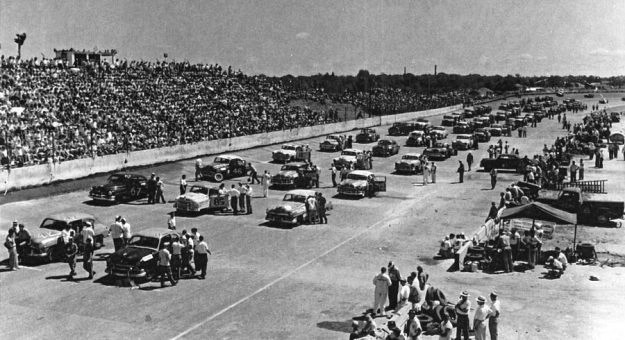
The origins of NASCAR can be traced back to the Prohibition era of the 1920s and early 1930s in the rural backroads of Appalachia and the southeastern United States. In those days, moonshine runners modified ordinary passenger vehicles by increasing their engine power, adding heavy-duty rear springs, removing excess weight, and incorporating other performance enhancements. The goal was to soup up the cars enough to outrun federal revenuers attempting to stop the widespread practice of illegally transporting moonshine whiskey.
These modified moonshine cars evolved into the first “stock cars” configured solely for speed and performance. The widespread popularity of modifying stock automobiles into high-powered racers during Prohibition spawned a transition after its repeal in 1933 into organized racing events matching the souped-up moonshine cars against one another on makeshift dirt courses.
By the late 1930s, these impromptu local races began drawing substantial crowds in areas like Daytona Beach, Florida, where the hard-packed sandy beachfront allowed drivers to reach higher speeds during competitions on a roughly 4-mile road course combining both the beach and portions of adjoining municipal streets.
The first major organized stock car race took place on February 15, 1936, at Daytona attracting an estimated 15,000 spectators. By that point, several drivers like Vida Hubbard and Lloyd Seay were locally renowned for their skills racing modified street vehicles adapted for speed rather than legal transportation.
In 1947, Bill France Sr., a local mechanic and ambitious auto racing entrepreneur, moved to Daytona Beach and was struck by the immense crowds showing up for stock car races on the beachfront road course. France envisioned forming an officially sanctioned championship circuit and sanctioning body to oversee and promote these events.
On December 14, 1947, France began gathering influential promoters, drivers, mechanics and other figures from the disparate local stock car racing scenes. After numerous organizational meetings held at the Streamline Hotel across from Daytona’s beach and road course, the group officially formed NASCAR (the National Association for Stock Car Auto Racing) on February 21, 1948, with France as its first president.
NASCAR held its first-ever sanctioned race on June 19, 1949, at the old Charlotte Speedway in North Carolina. In total, NASCAR’s inaugural 1949 season comprised eight races from Florida to Ontario. The series evolved through the 1950s from races predominantly held on beach and dirt road courses to longer-duration events being run on paved oval speedways constructed across the southeast.
During NASCAR’s formative years through the 1950s and into the 1960s, little was known about stock car racing outside of its regional southeastern base. Races were promoted largely at the local level, attracting sponsorships mostly from local companies and racetracks struggling for profitability.
In the summer of 1959, CBS aired portions of a 250-mile NASCAR race at Virginia’s Martinsville Speedway on its CBS Sports Spectacular program. Though not a live, complete race broadcast, this marked the first time any NASCAR event received national television coverage in the United States.
Television provided NASCAR with a platform to engage audiences well beyond its southeastern roots. On February 18, 1979, CBS aired the first live flag-to-flag coverage of the Daytona 500, one of NASCAR’s premier annual races, triggering a surge in the sport’s popularity throughout the 1980s. Major national sponsors like R.J. Reynolds, Anheuser-Busch and DuPont soon flooded NASCAR with funding to align their brands with the sport’s emerging wave of stars.
In the 1980s and 1990s, legendary drivers like Richard Petty, Bobby Allison, Darrell Waltrip, Dale Earnhardt, Jeff Gordon, and the late Dale Earnhardt Sr. elevated NASCAR into a major mainstream sports property. These generational talents generated fierce fan loyalty and on-track rivalries. Seemingly every week, their heroic performances thrilled audiences either in-person or through the rapidly increasing live television coverage.
To meet the soaring demand, NASCAR began expanding its reach beyond southeastern speedways by establishing races at new permanent oval and road course circuits constructed across America’s major markets. For the first time, NASCAR was no longer just an event rooted in the Deep South but a burgeoning national sporting attraction. Facilities like Chicagoland Speedway, Texas Motor Speedway, and Auto Club Speedway in California joined the NASCAR circuit.
By the early 21st century, NASCAR was drawing nearly 100,000 spectators per race at many of its biggest events. The sport’s popularity spiked in 2001 following the tragic death of Dale Earnhardt, one of NASCAR’s all-time transcendent superstars, in a last-lap crash at the Daytona 500. The groundswell of public attention and raw emotion from Earnhardt’s demise spotlighted the human drama inherent in NASCAR racing in a way that attracted millions of new fans.
Originally conceived as a series built around modestly souped-up Detroit-produced sedans, the contemporary NASCAR racecars of today have evolved into radical purebred racing machines bearing little exterior resemblance to any motor vehicle found on public roads. At a cost exceeding $25 million per car, NASCAR’s technological arms race continuously pushes development of lighter weight composite materials, advanced aerodynamics and fuel injection systems. Modern NASCAR racecars can exceed 200 mph and produce more than 850 horsepower from heavily modified production-based V8 engines.
Throughout NASCAR’s astonishing rise from a disorganized cluster of regional promoters to a multibillion-dollar sports entertainment industry, its core essence remains grounded in its historical legacy. The moonshine bootleggers evading federal agents would likely stand in awe at the cutting-edge race machinery and corporate infrastructure that has developed around their once-clandestine practice of modifying stock passenger cars into powerful racing vehicles.
However, the passion for speed, competition, mechanical ingenuity, and mastery of the driving craft that spawned stock car racing remains unchanged from NASCAR’s humble origins on the rural backroads of the American South to the massive superspeedways that now host its races before millions of fans in-person and through television partners like Fox and NBC.
What began as an outlaw pursuit fueled by prohibition has now transformed over three-quarters of a century into one of America’s signature sports entertainment properties operating at the vanguard of racing technology and safety. Yet, the soul of NASCAR remains forever rooted in those daring bootleggers who first pioneered the act of modifying ordinary production vehicles for the sole purpose of going faster than anything else on the road.

 Full Throttle Media
One thought on “From Bootleggers to Billionaires: The Improbable Evolution of NASCAR”